"15 July Democracy and National Unity Day 10th Anniversary Commemoration Program" was organized in cooperation with Üsküdar University Postcolonial Studies Application and Research Center (PAMER) and the Association of Advocates of Justice (ASDER) in order to protect democratic values, strengthen national will and keep social memory alive.
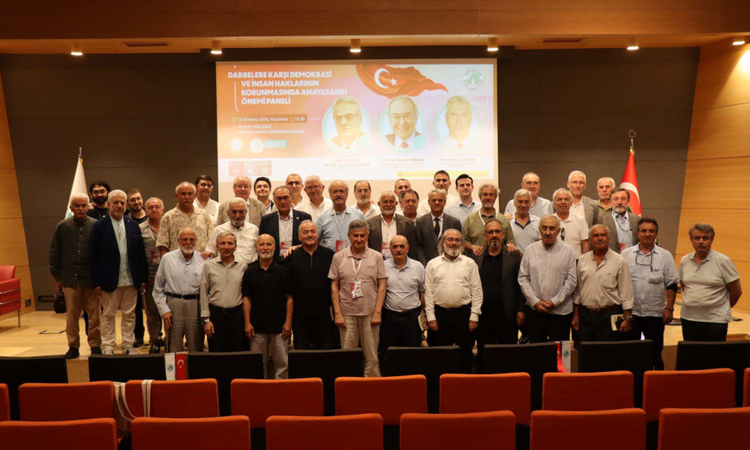
The panel titled "The Importance of the Constitution in the Protection of Democracy and Human Rights Against Coups", which was held within the scope of the commemoration program, was held at Üsküdar University Central Campus Nermin Tarhan Conference Hall.
The event started with the screening of a promotional film about July 15. Making the opening speech of the program, Üsküdar University Postcolonial Studies Application and Research Center Director Dr. Lecturer Member Fehmi Ağca said that coup periods deeply affected not only the political system, but also human rights and social structure.
In his speech, Dr. emphasized that the constitution is a social contract that regulates the basic organs of the state and the fundamental rights and freedoms of individuals. Ağca evaluated Türkiye's coup history chronologically and explained the effects of the interventions from May 27, 1960 to July 15, 2016 on democracy and legal order.
Stating that the common feature of coups is to target the will of the nation, Dr. Ağca said, "The most obvious common features of coups are that they want to establish an illegitimate order by overthrowing the legitimate governments elected by the free will of the nation and that they always have external support. We can easily understand this from the first decisions taken by the coup administrations." he said.
Dr. Ağca stated that coups violate many constitutional guarantees, especially the basic characteristics of the state, sovereignty, equality before the law, freedom of thought and conscience, the right to education and the right to activity, and said, "As far as I see, artificial fault lines are created in society before coups, and coup plotters always hide behind the mask of 'Kemalistism' to legitimize themselves. They all did this, including FETO." he said.
Dr. Lecturer In the panel moderated by member Fehmi Ağca, Prof. Dr. Nevzat Tarhan and Retired Judge, Senior Colonel and ASDER President Namık Kemal Urhan made evaluations.
Üsküdar University Founding Rector Prof. Dr. Nevzat Tarhan started his speech by emphasizing that coups should not be considered only as a military uprising.
"The danger will not end unless the coup ideology behind the coups is eliminated." said Prof. Dr. Tarhan said:
"Coupism is actually a mental design, a mentality. Before a coup plotter takes action, he silences his conscience, then takes his mind captive and finally his finger goes to the trigger. It is not just a finger that pulls the trigger; behind it is a mentality whose conscience is silenced and whose mind is surrendered."
Pointing out the importance of keeping July 15 alive in social memory, Prof. Dr. Tarhan said, "We need to keep alive in our country's institutional and social memory why the July 15 treacherous coup attempt took place. If we lose the social memory and forget what happened, we will prepare the ground for new coup attempts in the future." he said.
Stating that July 15 was not only a coup attempt but also a great test of democracy for the nation, Prof. Dr. Tarhan, "Toplumların tarihini sadece kazandıkları zaferler değil, verdikleri büyük imtihanlar da yazar. 15 Temmuz da milletimiz için tarihi bir imtihandı. O gece halka rağmen hiçbir gücün vesayet kuramayacağına dair güçlü bir milli irade ortaya konuldu." he said.
Prof. argued that the coup attempt was organized by a planned structure. Dr. Tarhan said, "This coup attempt was not an action planned by a few people within the Turkish Armed Forces on their own. It was a trans-Atlantic operation with global intelligence services behind it." he stated.
Prof. Dr. Tarhan stated that coups harmed not only democracy but also economic development and said, "In the 1960s, the per capita national income of South Korea and Türkiye was almost the same. While South Korea is producing world brands today, one of the most important reasons why we are not at the same point is the coups that occur every ten years, the suspension of the law and the consumption of development energy." he said.
Emphasizing that lessons should be learned from the past, Prof. Dr. Tarhan pointed out the importance of raising future generations consciously against the coup mentality and made the following assessment:
"Our aim is never to seek revenge. Our aim is to understand what this historical disaster teaches us and to create a strong democratic antibody against the coup mentality in the minds of future generations."
Prof. Dr. Nevzat Tarhan stated that coups should be handled not only with their military but also with their sociological, psychological and institutional dimensions and said, "In order to prevent another coup, security measures alone are not enough; the mentality that produces coups must also be eliminated." he said.
Prof. Dr. In his speech, Tarhan stated that the structural arrangements made after July 15 significantly reduced the possibility of a coup in Türkiye, and drew attention to the importance of keeping the memory of the society alive and institutionalizing democracy.
Prof. stated that in the past, some structures had the means and ability to stage a coup within the state. Dr. Nevzat Tarhan said, "No force should be given the opportunity and ability to stage a coup, not only in the army but also in any institution of the state. A person may be religious in the army, have different beliefs, but once he is organized, he will have the power to stage a coup. This is the real danger." he said.
Prof. devoted a part of his speech to the February 28 process. Dr. Tarhan stated that the methods applied at that time expanded the base of FETO and said, "On February 28, a 'controlled tension strategy' of psychological warfare was applied. The religious segment of the society was shown as a threat. It was said 'fighting against reactionism', but in fact they were fighting against religion." he said.
Stating that this approach has serious social consequences, Prof. Dr. Tarhan said, "Religious people were hurt and excluded. FETO silently welcomed everyone with open arms. It used sincere people for its own dirty purposes by saying 'Religion is going out of hand, take refuge in us'. This sociological analysis needs to be done well." he said.
Prof. Dr. Tarhan established a direct relationship between February 28 and July 15 and said, "We should never forget that February 28 gave birth to July 15, and almost became pregnant with July 15." he said.
Evaluating coups with a biological analogy, Prof. Dr. Tarhan said, "Just as diseases occur when a person's immune system is weakened, coups and chaos occur when the state is weakened." he stated.
Prof. Dr. Tarhan stated that for this reason, both security institutions should be strengthened and social unity should be protected, and said, "We must keep our Armed Forces strong. At the same time, we must be careful against provocateurs who scratch the differences in society. We have to implement unifying policies, not polarizing." he said.
Prof. Dr. Tarhan also pointed out the importance of including the culture of democracy in the military education curriculum and said, "At that time, we said, 'Democracy course should definitely be included in the Military Academy curriculum.' I asked, and today there is still no democracy course in the Military Academy. Unfortunately, there is not." he said.
ASDER President Namık Kemal Urhan said that while FETO has been operating under the guise of a "service community" for years, it has created an illegal organization with a cellular structure in the background. Stating that the organization acts on the basis of strict hierarchy and confidentiality, Urhan stated that the members are organized in a way that they only recognize the person above and below them.
Urhan said, "FETO has established a systematic structure extending from education to bureaucracy."
Urhan, who shared his experiences as a lawyer working in the July 15 cases, stated that members of the organization follow a common denial strategy even in the courts, and said that this reveals the discipline and control mechanism of the organization.
Urhan stated that today the state has learned important lessons from the past and that no structure is allowed to create a monopoly within the state and institutional measures against similar structures have been strengthened.
The panel ended after presenting gifts to the speakers and taking a group photo.