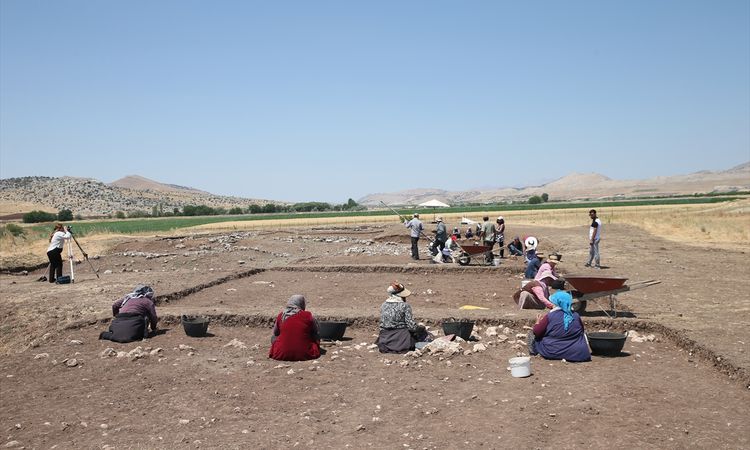
Excavation activities, which first began in 1965 at the 12,000-year-old Çayönü Tepesi in Diyarbakır's Ergani district and were later halted, have resumed in the western section after 50 years.
Çayönü Tepesi, which sheds light on world civilization history, is among the first places where the transition from nomadism to settled life, from hunting and gathering to production, and the beginning of agriculture occurred.
The first excavations at Çayönü, located in the Ergani Plain on the banks of the Dicle River, with settlement phases dating back to 10,000 BCE and discovered during surface surveys in 1963, were initiated in 1964 by Dr. Halet Çambel and Prof. Dr. Robert J. Braidwood.
Through the excavation activities at Çayönü, which holds great importance not only for the region but also for world civilization history, all stages and details of continuous life are being unearthed.
This year, excavation and research activities are being carried out with a team of 29 people at Diyarbakır's Çayönü Tepesi, which sheds light on world civilization history and where all stages and details of the transition to agriculture and the domestication of animals have been reached.
"We want to re-evaluate the data from the excavations of that period in the area."
Assoc. Prof. Dr. Sarıaltun told an AA correspondent that they had previously started excavation activities in the eastern section of the settlement, identified different phases of Neolithic settlement in the eastern section, and have paused these excavations as of this year.
Sarıaltun noted that Çayönü Tepesi is one of the first settlements in Turkey where systematic scientific excavations were conducted, stating that there are important clues at Çayönü regarding the beginning of settled life and the presence of the first Neolithic settlements here.
Sarıaltun stated that the new phase of excavation activities at Çayönü Tepesi began with intensive environmental cleaning carried out after the spring rains, and that as of early May, they commenced excavation activities under the coordination of a 9-person expert team consisting of archaeologists, architects, engineers, and restorers, along with 20 workers.
Explaining that excavation activities were carried out in the eastern section of Çayönü Tepesi in previous years, Sarıaltun noted the following:
"This year, we focused our excavations on the western area of the settlement. In previous years, we conducted our excavations in the eastern area. We worked intensively in an area of approximately 3,200 square meters. After defining the dwellings, workshops, ateliers, and superimposed periods we found in that area, we decided that we needed to return to excavations in the western area of Çayönü Tepesi after approximately 50 years. This area was first excavated in 1965 but the excavations were terminated after a while. In