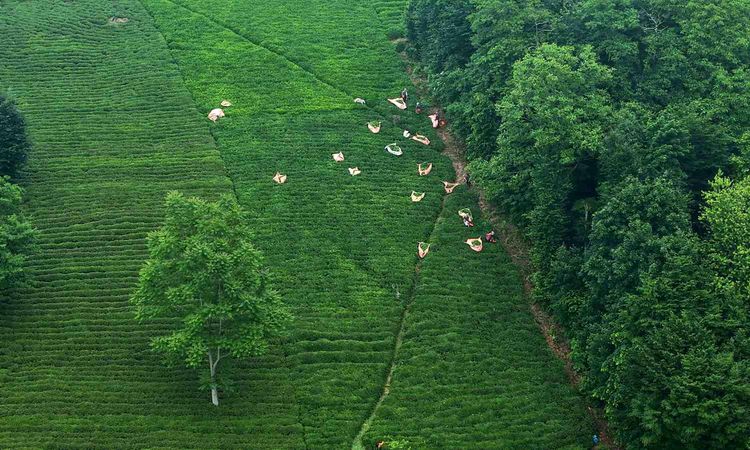
The journey of millions of cups of tea in Türkiye continues with the hard work done on the high steep slopes of the Eastern Black Sea Region. In the Eastern Black Sea region, where almost all of Türkiye's fresh tea production takes place, thousands of producers deliver the tea they collect from gardens to purchasing centers three times a year, marking the first step of the journey that reaches millions of tables.
The journey of tea from the gardens to the cup begins with the first light of the day on the steep slopes of the Eastern Black Sea Region. Thousands of producers in Rize, Trabzon, Artvin and Giresun deliver fresh tea from gardens to purchasing centers, working hard on manpower in steep terrain where the use of machinery is not possible at most points. In the Eastern Black Sea region, where almost all of Türkiye's fresh tea production takes place, tea farming is among the main sources of income for the regional economy. While 1 million 338 thousand tons of fresh tea was processed in the region in 2025, most of the product was converted into dry tea in public and private sector factories.
While the producers entered the tea gardens with the first shoot that started in May, the second shoot tea harvest continues these days. During the harvest, which is carried out three times a year, the young shoots called "two and a half leaves", which determine the quality, are carefully collected. Although motorized tea cutting machines and tea shears are used today in the harvest, which was carried out entirely by manual labor in the past, manpower continues to be the most important element of production due to the rugged structure of the region.
The steep slopes rising rapidly from the sea make tea production one of the most challenging agricultural activities in the world. While some gardens cannot be reached by vehicle, producers carry the tea they collect on their shoulders or backs after hours of harvesting and deliver it to the roadsides and purchasing points. During the harvest period, family members, neighbors and seasonal agricultural workers work together. Especially in rural neighborhoods, tea picking is kept alive as a culture of solidarity passed down from generation to generation. In periods when the need for labor increases, seasonal workers from different provinces and abroad also contribute to production.
Fresh teas collected by producers are delivered to public purchasing places and private sector facilities. Here, the products are weighed and recorded, and after quality checks, they are shipped to factories for processing. While long vehicle and producer queues form at the purchasing centers during peak harvest periods, quota applications can also be put into effect if the daily processing capacity is exceeded.
Trabzon's neighborhood green with tea: Kıranköy
Approximately 68 percent of the fresh tea produced in Türkiye is harvested in Rize, 19 percent in Trabzon, 11 percent in Artvin and 2 percent in Giresun. All tea production throughout the country is carried out in these four provinces. Although the first city that comes to mind when tea is mentioned is Rize, Kıranköy District of Trabzon's Vakfıkebir district also stands out as one of the important centers where production has been carried out for years. The ongoing harvest work on the steep slopes and the intense labor put in by the producers reveal one of the region's little-known tea production points.
In Kıranköy District, producers work hard to harvest the teas grown on the steep slopes. Tea, which was planted years ago as an alternative crop in the neighborhood where hazelnut production cannot be done due to its high altitude, continues to be one of the important sources of income for the people of the region today.
Mustafa Tosun, who has been a tea producer for about 26 years, said that this year they experienced the most productive harvest period in recent years. Tosun said, "Since the region we are in is at a high altitude, hazelnuts do not grow here. Tea was planted as an alternative crop years ago. This year's harvest was very productive. I have been producing here since 2000. We are experiencing one of the most productive seasons we have ever had. We cut the tea and brought it to the warehouse. The expert will come and receive the products."
"I love doing this job and I'm proud of it"
Çeşminaz Çavuş, who stated that she got used to the difficulty of picking tea, said, "I have been helping my uncle in the tea harvest for about 10 years. Collecting tea is difficult, but we have gotten used to it now. I love this job and I am proud of it. Our work does not end after the tea harvest is finished. We have a vineyard, a garden, we will work there. Then the meadow harvest and hazelnut harvest will begin. The work of agriculture in the Black Sea never ends."
"We Black Sea women are used to difficulties"
Emine Çavuş, one of the residents of the neighborhood, said that women engaged in agriculture in the Black Sea region spend most of the year in production. Sergeant said, "We both collect tea and take care of hazelnuts to earn our children's sustenance. This year's rains were very beneficial for the development of tea. When the sun came out, the tea grew in a short time and we had a good harvest. After the tea, the cleaning of the hazelnut gardens will begin. This year, since the tea and hazelnut seasons coincide, the work has become even more intense. Tea harvesting is quite tiring, especially due to the steep terrain. But there is nothing to do. We Black Sea women are used to difficulties. We earn our bread from the stone." he said. - TRABZON