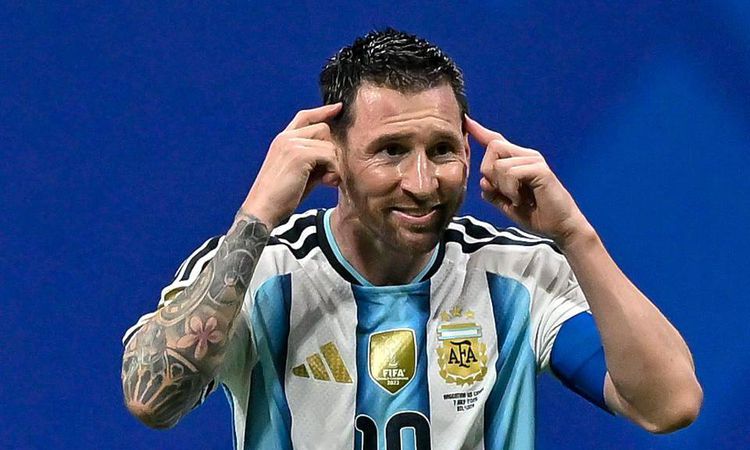
Although Lionel Messi could not score against England in the separate final on July 15, he was the architect of his country's 2-1 victory.
The Argentinian star carried his team to the 2026 World Cup final with two assists.
This will be Messi's third World Cup final.
The thirty-nine-year-old captain is still the most important player of the Argentine National Team.
He is also in the top scorer race in this tournament and continues to expand his record collection that he has created throughout his career of more than 20 years.
According to many football commentators, this World Cup, jointly organized by the USA, Mexico and Canada, was not only a new turning point in Messi's career, but also one of the last links of the journey that placed him at the center of the debate about the greatest player in the history of football.
The question of whether Messi is the "greatest football player of all time" actually started to be asked long before the 2022 World Cup victory in Qatar.
However, this debate has always had a different dimension in Argentina. The name with which Messi has been compared for many years is Diego Maradona, the captain who won the 1986 World Cup.
Maradona's influence extended far beyond football.
Spanish journalist Guillem Balagué summarizes Maradona as follows in his interview with BBC Brasil:
"He was the king of Argentina. And a king is not elected; he just represents the country."
The view on Messi began to change with Argentina's 2021 Copa América title.
With the victory of the 2022 World Cup, this debate has largely ended.
Messi proved himself to many people in his country by making Argentina world champions for the third time.
However, according to Balagué, this success did not completely end the debate.
"Today, Messi has surpassed Maradona as a football player. But still, some Argentines will continue to say that Maradona represents them better."
Outside Argentina, some football authorities go one step further and argue that Messi has now surpassed Brazilian Pelé, who has been considered the "King of Football" for many years.
If statistics alone were enough to determine the greatest player in football history, this debate would be over long ago.
Messi is the football player who has won the most Ballon d'Or awards.
He won almost every possible trophy with the jerseys of Barcelona, Paris Saint-Germain, Inter Miami and the Argentine National Team.
won the Copa América and the World Cup; He held goals and assists records in both his club and national team careers.
Despite this, for many years many in Argentina continued to rank Maradona ahead of him.
According to Balagué, this is because Maradona has become not only a great football player, but also one of the strongest symbols of Argentine identity:
"For many years, Argentina has seen itself as a special and different country from other countries. Football has become one of the most important ways to prove this greatness."
In this context, Balagué points out that Maradona is not just a star football player:
"He came from a very poor family. He challenged all kinds of authority. He could say what he thought to the Pope or the head of state. He was rebellious, genius and charismatic. Many Argentines saw their identity in these characteristics of him."
Messi, however, followed a completely different path.
He remained quiet off the field. He refrained from making political statements. He was trying to build a distinct public character, and one of his most repeated phrases throughout his career was "I just want to play football."
This difference is also seen in the assessment of former Australian footballer Craig Foster.
In his interview with the British newspaper The Guardian, Foster said that he preferred Maradona to Messi because Maradona also talked about issues outside of football. He argued that Messi represents the typical example of a modern football player.
"I don't like Messi as much as Maradona because he doesn't talk about anything. Like David Beckham or Cristiano Ronaldo. These are modern athletes; they don't express their opinions about anything. They act as if there is no world outside football."
Balagué, on the other hand, thinks that Messi's introverted personality has begun to be perceived differently over time, thanks to his successes with the national team.
After the 2021 Copa América victory and especially the World Cup title in Qatar, many Argentines discovered aspects of their captain that they had not seen before.
Throughout the tournament, Messi showed unusual displays in his career. He argued with his opponents, provoked them verbally, and the player who was seen as a silent leader for years turned into a captain who lived his emotions more openly. This attitude was identified by many with Maradona's leadership.
"Messi showed new aspects of his character. He began to be seen as the true commander of the team. This was one of the characteristics that Maradona had for years."
One of the most important reasons why there is no consensus on who the greatest player in football history is is that football has changed radically in the last 50 years.
When Pelé won the first World Cup in 1958, football players were traveling on chartered flights and playing on rough grounds. He was fighting against referees without technological support such as VAR and was going through physical preparation programs that could be considered quite primitive by today's standards.
In the 1980s, when Maradona became a star, football began to turn into a global spectacle. However, it was still a far cry from the multi-billion dollar industry it is today.
Messi, on the other hand, spent almost his entire career in a completely different football world.
Broadcasting rights and sponsorship revenues increased exponentially.
Sports physicians, performance analysts, physiotherapists, nutritionists and sports psychologists have become an integral part of the football players' preparation processes.
Improvements in physical recovery methods have also enabled significant extensions of careers that in the past would have ended much earlier.
Technology has not only changed players' preparation, but also the way the game is analyzed.
Today, almost every match is recorded with dozens of cameras. The performance of the actors can be examined in minute detail.
While VAR changes referee decisions, advanced statistics can measure many data, from pressure in off-ball play to goal expectation.
On the other hand, it is harder than ever for football players to hide their shortcomings.
When Pelé and Maradona played, many matches were not broadcast on international television at all. As for Messi, almost his entire career was transferred in high definition; His every move was analyzed moment by moment by experts, social media and millions of fans.
Being constantly in the spotlight makes it even more difficult to compare football players from different eras. Because in fact, no generation struggled under the same conditions.
Ronaldo, one of the legendary names of Brazilian football, recently said that in order for this discussion to be held in a healthy way, common criteria should be determined first.
Speaking to Romário TV, Ronaldo described Messi as "an incredible genius" and ranked him among the five best players in the history of football. However, he did not express a clear opinion on whether the Argentinian was superior to Maradona.
"In order to discuss this, we first need to determine a criterion. How can such a choice be made without a common criterion?" he said.
In fact, this question constitutes the essence of the discussion.
Is it really possible to compare players who are more than half a century apart, who play by different rules, who have different fixture intensities, who grew up with different training methods, and who play football under completely different social expectations?
Maybe that's why this debate starts anew with each generation and never reaches a definitive conclusion, despite extraordinary careers.
Although there is no consensus on who the greatest player in football history is, there are some common reasons frequently expressed by those who place Messi at the top.
The most important of these is the ability to stay at the top level for a long time.
While Pelé and Maradona had limited periods of peak performance in their careers, Messi managed to be one of the top players in world football for nearly 20 years.
He won championships in both league, continental and international organizations at different periods of his career.
This stability is seen as one of the most important features that make it different.
But this also shows how football has changed.
Messi pursued his career in an era where billions of dollars were invested in sports medicine, physiology, nutrition, performance analysis and physical recovery.
These situations have made it possible for football players to perform at a high level for longer periods of time, allowing them to compete at an elite level at ages that would have been unimaginable in the past.
However, experts emphasize that these advantages do not overshadow Messi's individual success. Because although the number of players who can play for longer periods has increased, very few have been able to reach the level of stability and quality that Messi has maintained for nearly twenty years.
Another factor that makes Messi stand out is that he can maintain the same level in different conditions.
According to Thierry Henry, with whom he played in Barcelona, one of the most important reasons for this is Messi's extraordinary competitive character.
In the interview carried by the Spanish newspaper Marca, Henry recalls Barcelona training sessions and explains that Messi transformed into a completely different player when he thought he was being treated unfairly.
"Do not wake the monster," he warns.
The French legend says that when he thought the referee did not give a foul, Messi got angry and started scoring goals one after another.
However, not everyone shares the same opinion.
Tostão, one of the important names of Brazilian football, said in an interview with Radio Villa Trinidad in Argentina in 2021 that Messi had passed Maradona, but was still behind Pelé.
"I have been thinking about this for many years. After Pelé, the best player in the history of football is Messi. He is ahead of Maradona because he is a more complete football player and has a much longer career," he said.
According to Tostão, the main difference between Pelé and Messi is their physical characteristics:
"The only difference between Pelé and Messi is that Pelé is physically stronger, more athletic and more aggressive. In terms of talent, Messi is on the same level as Pelé."
Pelé, Maradona and Messi played in different eras, with different rules, in different fixtures and in a football world that was undergoing great change.
Pelé became the symbol of the years when football began to transform into a global spectacle.
Maradona has become a political and cultural icon that goes beyond sports. Messi, on the other hand, shaped his career as one of the biggest stars of the modern football era determined by globalization, sports science and social media.
Perhaps it will never be possible to make a definitive ranking between three players who grew up under such different conditions.
That's why the question of who is the greatest player in football history continues to be asked anew with every new generation.