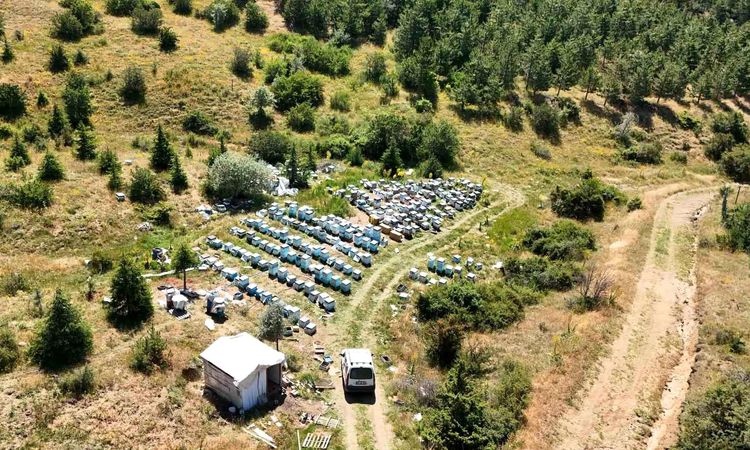
Yozgat, which is on its way to becoming one of Türkiye's important honey production centers, offers beekeepers a productive season with its rich plant flora. Especially in Yozgat, which provides nectar for a long time thanks to its high altitude and the succession of different plant species blooming, both local and wandering beekeepers are hopeful about the new season.
Beekeepers producing in Yozgat Çamlık Honey Forest stated that the nectar potential of the region is high, and that the sequential flowering of different plant species positively affects honey yield.
"The flora of Çamlık Bal Forest is really beautiful"
Ahmet Mümtaz Çakıroğlu, who has been engaged in beekeeping for about 17 years, stated that he continued his father's job after his retirement and said that Çamlık Honey Forest is an important region in terms of beekeeping. Çakıroğlu said, "I am retired from the civil service. I have been beekeeping for about 17 years. This is our father's profession. I hope we continue beekeeping after retirement. Now, this is Yozgat Çamlık Honey Forest. We started with 117 hives last year, and this year we have nearly 300 hives. The nectar of the Çamlık Honey Forest is really beautiful, its flora is very beautiful. It has a wonderful flora. I hope it will also be available during the honey cutting period. "We are planning to buy 25 to 30 kilos of honey per hive," he said.
Stating that the harvest was made later than other regions due to the high altitude of Yozgat, Çakıroğlu wished the producers a fruitful season. Çakıroğlu said, "Harvest is a little later here. This is a place with an altitude of approximately 1,300,350 meters. We harvest at the beginning of the ninth month, at the end of the eighth month. Harvest has started in some places in our region. I hope our friends have a fruitful season. We will harvest our honey around the end of the eighth month, inshallah. Generally, I do retail sales. There are places where I wholesale to a few places, but my focus is on retail sales. This year, 750 to 1,500 kilos." "We think there will be production between," he said.
Mehmet Töngel, who came to Yozgat from Fatsa district of Ordu to do migratory beekeeping, said that Yozgat's plant diversity provides a great advantage in terms of honey production. Töngel said, "I am a migratory beekeeper in Yozgat. We move here in the spring when the plateaus warm up and the greenery, grass and flowers appear. In the autumn, around September or October, we return to Ordu, our hometown. When we first came here, we had four hundred bees. When we gave birth to swarms, it has now exceeded five hundred. I cannot say it very clearly as there is no yield. My situation here is a little better compared to previous years. Now the land is open here, so the vegetation is very rich. "For example, how many types of thyme are there, especially astragalus? God Almighty has arranged it in such a way that they don't all bloom at once. White thyme blooms, purple thyme blooms earlier, so the sequence never ends," he said.
While Yozgat's rich vegetation provides a source of nectar to bees for a long time thanks to endemic and natural plant species that bloom in different periods, producers state that this natural cycle contributes significantly to the production of quality and efficient honey. Particularly the consecutive blooming of astragalus, thyme and many wildflowers makes Yozgat one of the important production centers preferred by migratory beekeepers. - YOZGAT